Find the value of f((pi)/(2))f\left(\frac{\pi}{2}\right).
Answer:
Introduction
The problem asks us to find the value of f((pi)/(2))f\left(\frac{\pi}{2}\right) for a given function f(x)=(cos^(2)x)/(4x^(2)-pi^(2))f(x) = \frac{\cos^2 x}{4x^2 – \pi^2} defined on the interval [0,(pi)/(2)]\left[0, \frac{\pi}{2}\right]. The function is continuous except at x=(pi)/(2)x = \frac{\pi}{2} because the denominator becomes zero at that point. To find f((pi)/(2))f\left(\frac{\pi}{2}\right), we’ll need to evaluate the limit of f(x)f(x) as xx approaches (pi)/(2)\frac{\pi}{2}.
To find the limit, we can use L’Hôpital’s Rule, which states that if lim_(x rarr a)(f(x))/(g(x))\lim_{{x \to a}} \frac{f(x)}{g(x)} is an indeterminate form (0)/(0)\frac{0}{0} or (oo )/(oo)\frac{\infty}{\infty}, then:
The value of f((pi)/(2))f\left(\frac{\pi}{2}\right) is 00. We used L’Hôpital’s Rule to evaluate the limit of the function f(x)f(x) as xx approaches (pi)/(2)\frac{\pi}{2}, and found that the limit is 00. Therefore, f((pi)/(2))=0f\left(\frac{\pi}{2}\right) = 0.
(b) माना कि f:D(subeR^(2))rarrRf: D\left(\subseteq \mathbb{R}^2\right) \rightarrow \mathbb{R} एक फलन है और (a,b)in D(a, b) \in D. अगर f(x,y)f(x, y) बिंदु (a,b)(a, b) पर संतत है, तो दर्शाइए कि फलन f(x,b)f(x, b) और f(a,y)f(a, y) क्रमशः x=ax=a और y=by=b पर संतत हैं।
Let f:D(subeR^(2))rarrRf: D\left(\subseteq \mathbb{R}^2\right) \rightarrow \mathbb{R} be a function and (a,b)in D(a, b) \in D. If f(x,y)f(x, y) is continuous at (a,b)(a, b), then show that the functions f(x,b)f(x, b) and f(a,y)f(a, y) are continuous at x=ax=a and at y=by=b respectively.
Answer:
Introduction
The problem asks us to prove that if a function f(x,y)f(x, y) is continuous at a point (a,b)(a, b), then the functions f(x,b)f(x, b) and f(a,y)f(a, y) are continuous at x=ax = a and y=by = b respectively. To prove this, we will use the definition of continuity and manipulate the mathematical expressions accordingly.
Work/Calculations
Step 1: Definition of Continuity
A function f(x,y)f(x, y) is said to be continuous at (a,b)(a, b) if for every epsilon > 0\epsilon > 0, there exists delta > 0\delta > 0 such that:
Thus, we have shown that f(a,y)f(a, y) is continuous at y=by = b.
Conclusion
We have successfully proven that if f(x,y)f(x, y) is continuous at (a,b)(a, b), then f(x,b)f(x, b) is continuous at x=ax = a and f(a,y)f(a, y) is continuous at y=by = b. We used the definition of continuity to establish these results.
(c) माना कि T:R^(2)rarrR^(2)T: \mathbb{R}^2 \rightarrow \mathbb{R}^2 एक रैखिक प्रतिचित्र है, जैसा कि T(2,1)=(5,7)T(2,1)=(5,7) एवं T(1,2)=(3,3)T(1,2)=(3,3). अगर AA मानक आधारों e_(1),e_(2)e_1, e_2 के सापेक्ष TT के संगत आव्यूह है, तो AA की कोटि ज्ञात कीजिए।
Let T:R^(2)rarrR^(2)T: \mathbb{R}^2 \rightarrow \mathbb{R}^2 be a linear map such that T(2,1)=(5,7)T(2,1)=(5,7) and T(1,2)=(3,3)T(1,2)=(3,3).
If AA is the matrix corresponding to TT with respect to the standard bases e_(1),e_(2)e_1, e_2, then find Rank(A)\operatorname{Rank}(A).
Answer:
Expressing (a,b)(a, b) as a Linear Combination
(a,b)=alpha(2,1)+beta(1,2)(a, b) = \alpha(2,1) + \beta(1,2)
The problem asks us to show that AB=6I_(3)AB = 6I_3 for given matrices AA and BB, and then use this result to solve a system of equations. I_(3)I_3 is the 3xx33 \times 3 identity matrix.
Work/Calculations
Step 1: Calculate ABAB
The first task is to calculate ABAB. The matrices AA and BB are:
This is equivalent to 6I_(3)6I_3, where I_(3)I_3 is the 3xx33 \times 3 identity matrix.
Step 2: Solve the System of Equations
The system of equations is:
{:[2x+y+z=5],[x-y=0],[2x+y-z=1]:}\begin{aligned}
2x + y + z &= 5 \\
x – y &= 0 \\
2x + y – z &= 1
\end{aligned}
We can write this system as Ax=bAx = b, where AA is the matrix from the problem statement, and b=([5],[0],[1])b = \begin{pmatrix} 5 \\ 0 \\ 1 \end{pmatrix}.
” Since “AB=6I_(3)”, we have “A^(-1)=(1)/(6)B”. “\text { Since } A B=6 I_3 \text {, we have } A^{-1}=\frac{1}{6} B \text {. }
(x+1)/(-3)=(y-3)/(2)=(z+2)/(1)” और “(x)/(1)=(y-7)/(-3)=(z+7)/(2)\frac{x+1}{-3}=\frac{y-3}{2}=\frac{z+2}{1} \text { और } \frac{x}{1}=\frac{y-7}{-3}=\frac{z+7}{2}
प्रतिच्छेदी रेखाएँ हैं। प्रतिच्छेद बिंदु के निर्देशांकों और उस समतल, जिसमें दोनों रेखाएँ हैं, का समीकरण ज्ञात कीजिए।
Show that the lines
(x+1)/(-3)=(y-3)/(2)=(z+2)/(1)” and “(x)/(1)=(y-7)/(-3)=(z+7)/(2)\frac{x+1}{-3}=\frac{y-3}{2}=\frac{z+2}{1} \text { and } \frac{x}{1}=\frac{y-7}{-3}=\frac{z+7}{2}
intersect. Find the coordinates of the point of intersection and the equation of the plane containing them.
This is the equation of the plane containing the given lines.
(a) क्या f(x)=|cos x|+|sin x|,x=(pi)/(2)f(x)=|\cos x|+|\sin x|, x=\frac{\pi}{2} पर अवकलनीय है? अगर आपका उत्तर हाँ है, तो f(x)f(x) का अवकलज x=(pi)/(2)x=\frac{\pi}{2} पर ज्ञात कीजिए। अगर आपका उत्तर ना है, तो अपने उत्तर का प्रमाण दीजिए।
Is f(x)=|cos x|+|sin x|f(x)=|\cos x|+|\sin x| differentiable at x=(pi)/(2)x=\frac{\pi}{2} ? If yes, then find its derivative at x=(pi)/(2)x=\frac{\pi}{2}. If no, then give a proof of it.
Answer:
Introduction
We’re going to look at a pretty cool math problem. We have a function f(x)=|cos x|+|sin x|f(x) = |\cos x| + |\sin x|, and we want to find out if it’s differentiable at x=(pi)/(2)x = \frac{\pi}{2}. If it is, we’ll also find its derivative at that point. To make things easier, we’ll break down the function into a piecewise function and then check its differentiability.
Work/Calculations
Step 1: Breaking It Down
First, let’s rewrite f(x)f(x) as a piecewise function around x=(pi)/(2)x = \frac{\pi}{2}:
f(x)={[-cos x+sin x,”if “x < (pi)/(2)],[cos x+sin x,”if “x > (pi)/(2)],[1,”if “x=(pi)/(2)]:}f(x) =
\begin{cases}
-\cos x + \sin x & \text{if } x < \frac{\pi}{2} \\
\cos x + \sin x & \text{if } x > \frac{\pi}{2} \\
1 & \text{if } x = \frac{\pi}{2}
\end{cases}
Step 2: Checking the Derivative
To see if f(x)f(x) is differentiable at x=(pi)/(2)x = \frac{\pi}{2}, we need to find the derivative from both sides of that point and see if they match.
Left-hand derivative: The derivative of -cos x+sin x-\cos x + \sin x is sin x+cos x\sin x + \cos x.
Right-hand derivative: The derivative of cos x+sin x\cos x + \sin x is -sin x+cos x-\sin x + \cos x.
Now, let’s plug x=(pi)/(2)x = \frac{\pi}{2} into both of these derivatives and see what we get.
After calculating, we find that both the left-hand and right-hand derivatives at x=(pi)/(2)x = \frac{\pi}{2} are 11. That’s awesome because it means the function is differentiable at x=(pi)/(2)x = \frac{\pi}{2}
Conclusion
So, there we have it! The function f(x)=|cos x|+|sin x|f(x) = |\cos x| + |\sin x| is differentiable at x=(pi)/(2)x = \frac{\pi}{2}, and its derivative at that point is 11.
(b) माना कि AA और BB समान कोटि के दो लांबिक आव्यूह हैं तथा det A+det B=0\operatorname{det} A+\operatorname{det} B=0. दर्शाइए कि A+BA+B एक अव्युत्क्रमणीय (सिंगुलर) आव्यूह है।
Let AA and BB be two orthogonal matrices of same order and det A+det B=0\operatorname{det} A+\operatorname{det} B=0. Show that A+BA+B is a singular matrix.
Answer:
Proving that A + B is Singular
Given:
AA and BB are two orthogonal matrices of the same order.
det A+det B=0\det A + \det B = 0
We want to show that A+BA + B is a singular matrix.
Step 1: Given Orthogonal Matrices
Given that AA^(T)=BB^(T)=IAA^T = BB^T = I, where II is the identity matrix.
Also, det A=det B=1\det A = \det B = 1 because orthogonal matrices have a determinant of 11 or -1-1, and we’re given that det A+det B=0\det A + \det B = 0, which implies det A=-det B\det A = -\det B.
Step 2: Determinant of AB
We know that det A*det B=-1\det A \cdot \det B = -1. This implies that det(AB)=-1\det(AB) = -1. (This is due to the property of determinants that det(AB)=det(A)*det(B)\det(AB) = \det(A) \cdot \det(B).)
Step 3: Expressing A + B
Now, let’s express A+BA + B in terms of AA and BB:
A+B=AI+BI=A(B^(T)+A^(T))BA + B = AI + BI = A(B^T + A^T)B
Now, let’s focus on the determinant of the transpose sum:
{:[det(B^(T)+A^(T))=det((B+A)^(T))quad(Transpose of a sum)],[=det(B+A)]:}\begin{aligned}
\det(B^T + A^T) &= \det((B + A)^T) \quad \text{(Transpose of a sum)} \\
&= \det(B + A)
\end{aligned}
Step 6: Putting It All Together
Now, we can express det(A+B)\det(A + B) as:
det(A+B)=-det(B+A)\det(A + B) = -\det(B + A)
But A+B=B+AA + B = B + A because matrix addition is commutative.
So, we have:
det(A+B)=-det(B+A)=-det(A+B)\det(A + B) = -\det(B + A) = -\det(A + B)
This implies that 2det(A+B)=02\det(A + B) = 0.
Step 7: Conclusion
From the equation 2det(A+B)=02\det(A + B) = 0, we can conclude that det(A+B)=0\det(A + B) = 0.
A matrix is considered singular if its determinant is zero. Therefore, we have shown that A+BA + B is a singular matrix.
(c) (i) समतल x+2y+3z=12x+2 y+3 z=12 निर्देशांक अक्षों को A,B,CA, B, C पर प्रतिच्छेद करता है। त्रिभुज ABCA B C के परिवृत्त का समीकरण ज्ञात कीजिए।
(ii) सिद्ध कीजिए कि समतल z=0z=0 गोलक x^(2)+y^(2)+z^(2)=11x^2+y^2+z^2=11 के अन्वालोपी शंकु, जिसका शीर्ष (2,4,1)(2,4,1) पर है, को एक समकोणीय अतिपरवलय पर प्रतिच्छेद करता है।
(i) The plane x+2y+3z=12x+2 y+3 z=12 cuts the axes of coordinates in A,B,CA, B, C. Find the equations of the circle circumscribing the triangle ABCA B C.
Answer:
To find the equation of the circle circumscribing the triangle ABC, we start with the given plane equation:
x+2y+3z=12x + 2y + 3z = 12
This plane intersects the x-axis, y-axis, and z-axis at points A, B, and C, respectively. We’ve already found the coordinates of these points:
A(12, 0, 0)
B(0, 6, 0)
C(0, 0, 4)
Now, let’s assume the equation of the circumscribing circle is:
(ii) Prove that the plane z=0z=0 cuts the enveloping cone of the sphere x^(2)+y^(2)+z^(2)=11x^2+y^2+z^2=11 which has the vertex at (2,4,1)(2,4,1) in a rectangular hyperbola.
Answer:
Given the equation of the sphere S=x^(2)+y^(2)+z^(2)-11\mathrm{S}=\mathrm{x}^2+\mathrm{y}^2+\mathrm{z}^2-11 and the coordinates of its vertex (alpha,beta,gamma)=(2,4,1)(\alpha, \beta, \gamma)=(2,4,1).
Calculate S_(1)S_1 and the equation of the plane TT:
Write the equation of the enveloping cone of the sphere:
The equation of the enveloping cone can be written as T^(2)=SS_(1)\mathbf{T}^2 = \mathbf{S}\mathbf{S}_1, where T\mathbf{T} is the equation of the plane and S\mathbf{S} is the equation of the sphere.
The resulting equation is a rectangular hyperbola, which proves that the plane z=0z=0 cuts the enveloping cone of the sphere in a rectangular hyperbola.
(a) फलन f(x)=2x^(3)-9x^(2)+12 x+6f(x)=2 x^3-9 x^2+12 x+6 का अंतराल [2,3][2,3] पर अधिकतम और न्यूनतम मान ज्ञात कीजिए।
Find the maximum and the minimum value of the function f(x)=2x^(3)-9x^(2)+12 x+6f(x)=2 x^3-9 x^2+12 x+6 on the interval [2,3][2,3].
Answer:
Introduction
The problem asks us to find the maximum and minimum values of the function f(x)=2x^(3)-9x^(2)+12 x+6f(x) = 2x^3 – 9x^2 + 12x + 6 on the interval [2,3][2, 3]. To find these extremum points, we’ll use calculus methods, specifically by finding the derivative of the function and setting it equal to zero to find critical points. We’ll then evaluate the function at these critical points and the endpoints of the interval to determine the maximum and minimum values.
Work/Calculations
Step 1: Find the Derivative of f(x)f(x)
The first derivative of f(x)f(x) will give us the rate of change of the function at any given point xx.
After calculating, we find that the derivative of f(x)f(x) is:
f^(‘)(x)=6x^(2)-18 x+12f'(x) = 6x^2 – 18x + 12
Step 2: Find the Critical Points
To find the critical points, we set f^(‘)(x)=0f'(x) = 0 and solve for xx.
6x^(2)-18 x+12=06x^2 – 18x + 12 = 0
After solving, we find that the critical points are x=1x = 1 and x=2x = 2.
Step 3: Evaluate f(x)f(x) at Critical Points and Endpoints
To find the maximum and minimum values of f(x)f(x) on the interval [2,3][2, 3], we need to evaluate f(x)f(x) at the critical points and the endpoints of the interval. The critical points within the interval are x=2x = 2 and the endpoints are x=2x = 2 and x=3x = 3.
Let’s substitute the values into f(x)=2x^(3)-9x^(2)+12 x+6f(x) = 2x^3 – 9x^2 + 12x + 6 and calculate:
We evaluated f(x)f(x) at the critical point x=2x = 2 and the endpoint x=3x = 3 within the interval [2,3][2, 3]:
f(2)=10f(2) = 10
f(3)=15f(3) = 15
Therefore, the maximum value of f(x)f(x) on the interval [2,3][2, 3] is 1515 at x=3x = 3, and the minimum value is 1010 at x=2x = 2.
(b) सिद्ध कीजिए कि साधारणतः किसी एक बिंदु से परवलयज x^(2)+y^(2)=2azx^2+y^2=2 a z पर तीन अभिलंब बनाए जा सकते हैं, लेकिन अगर बिंदु सतह 27 a(x^(2)+y^(2))+8(a-z)^(3)=027 a\left(x^2+y^2\right)+8(a-z)^3=0 पर स्थित है, तो इन तीन अभिलंबों में से दो अभिलंब एक ही हैं।
Prove that, in general, three normals can be drawn from a given point to the paraboloid x^(2)+y^(2)=2azx^2+y^2=2 a z, but if the point lies on the surface
Introduction:
We are tasked with proving that, in general, three normals can be drawn from a given point to the paraboloid x^(2)+y^(2)=2azx^2+y^2=2az. However, if the point lies on the surface 27 a(x^(2)+y^(2))+8(a-z)^(3)=027a(x^2+y^2)+8(a-z)^3=0, then two of the three normals coincide.
Work/Calculations:
The equation of the normal at (x_(1),y_(1),z_(1))(x_1, y_1, z_1) to the paraboloid is given by:
Equation (2) is a cubic in lambda\lambda and has three values of lambda\lambda that satisfy it, leading to three points on the paraboloid normal at which pass through (alpha,beta,gamma)(\alpha, \beta, \gamma).
Rewriting equation (2) as a function f(lambda)f(\lambda):
To find the condition that equation (3) has two equal roots, we need to solve for lambda\lambda where both f(lambda)=0f(\lambda)=0 and f^(‘)(lambda)=0f'(\lambda)=0.
Differentiating f(lambda)f(\lambda) with respect to lambda\lambda to find f^(‘)(lambda)f'(\lambda):
Conclusion:
We have successfully shown that the locus of the point (alpha,beta,gamma)(\alpha, \beta, \gamma) is 27 a(x^(2)+y^(2))+8(a-z)^(3)=027a(x^2+y^2)+8(a-z)^3=0. This proves the given statement.
Cayley-Hamilton Theorem:
The Cayley-Hamilton theorem states that every square matrix satisfies its own characteristic equation over a commutative ring, such as the real or complex field. In other words, if lambda I-A\lambda I – A is the characteristic equation of a matrix AA, where II is the identity matrix and lambda\lambda is a scalar, then AA satisfies the equation |lambda I-A|=0|\lambda I – A| = 0.
First, let’s find the characteristic equation for matrix AA:
की अभिलंब जीवा की लंबाई ज्ञात कीजिए और सिद्ध कीजिए कि अगर यह 4PG_(3)4 P G_3 के समान है, जहाँ G_(3)G_3 वह बिंदु है जहाँ PP से गुजरने वाली अभिलंब जीवा xyx y-तल पर मिलती है, तो PP शंकु
and prove that if it is equal to 4PG_(3)4 P G_3, where G_(3)G_3 is the point where the normal chord through PP meets the xyx y-plane, then PP lies on the cone
Equation of the Normal:
Let P\mathrm{P} be (alpha,beta,gamma)(\alpha, \beta, \gamma), then the equation of the normal to the given ellipsoid at P(alpha,beta,gamma)P(\alpha, \beta, \gamma) are
Therefore, the coordinates of any point QQ on the normal (1) are (alpha+(P alpha)/(a^(2))r,beta+(P beta)/(b^(2))r,gamma+(p gamma)/(c^(2))r)\left(\alpha+\frac{P \alpha}{a^2} r, \beta+\frac{P \beta}{b^2} r, \gamma+\frac{p \gamma}{c^2} r\right), where rr is the distance of QQ from PP.
If Q\mathrm{Q} lies on the given ellipsoid i.e., PQ\mathrm{PQ} is the normal chord, then
=>r^(2)p^(2)((alpha^(2))/(a^(4))+(beta^(2))/(b^(6))+(gamma^(2))/(c^(6)))+2rp((1)/(p^(2)))=0[:}\Rightarrow r^2 p^2\left(\frac{\alpha^2}{a^4}+\frac{\beta^2}{b^6}+\frac{\gamma^2}{c^6}\right)+2 r p\left(\frac{1}{p^2}\right)=0\left[\right. from (2) and Sigma((alpha^(2))/(a^(2)))=1\Sigma\left(\frac{\alpha^2}{a^2}\right)=1 as p(alpha,beta,gamma)p(\alpha, \beta, \gamma) lies on the given conicoid ]
=>r=-(2)/(p^(3)((alpha^(2))/(a^(6))+(beta^(2))/(b^(6))+(gamma^(2))/(c^(6))))=” length of normal chord “PQ rarr(3)\Rightarrow r=-\frac{2}{p^3\left(\frac{\alpha^2}{a^6}+\frac{\beta^2}{b^6}+\frac{\gamma^2}{c^6}\right)}=\text { length of normal chord } P Q \rightarrow(3)
Also,
Let the normal at P(alpha,beta,gamma)P(\alpha, \beta, \gamma) meets the coordinate plane viz. yz,zxy z, z x and xyx y planes at G_(1),G_(2),G_(3)G_1, G_2, G_3 Then putting x=0,y=0x=0, y=0 and z=0z=0 in succession in the equation (1), we have respectively,
PG_(1)=-(a^(2))/(P),PG_(2)=-(b^(2))/(p)” and “PG_(3)=-(c^(2))/(p)rarr” (4) “P G_1=-\frac{a^2}{P}, P G_2=-\frac{b^2}{p} \text { and } P G_3=-\frac{c^2}{p} \rightarrow \text { (4) }
Conclusion:
We have found the length of the normal chord through a point PP on the given ellipsoid and proved that if this length is equal to 4PG_(3)4PG_3, then PP lies on the cone defined by the equation
है, तो दर्शाइए कि sin^(2)u,x\sin ^2 u, x और yy का -(1)/(6)-\frac{1}{6} घातविशिष्ट समांगी फलन है। अतएव दर्शाइए कि
x^(2)(del^(2)u)/(delx^(2))+2xy(del^(2)u)/(del x del y)+y^(2)(del^(2)u)/(dely^(2))=(tan u)/(12)((13)/(12)+(tan^(2)u)/(12))x^2 \frac{\partial^2 u}{\partial x^2}+2 x y \frac{\partial^2 u}{\partial x \partial y}+y^2 \frac{\partial^2 u}{\partial y^2}=\frac{\tan u}{12}\left(\frac{13}{12}+\frac{\tan ^2 u}{12}\right)
(ii) जैकोबियन विधि का व्यवहार करते हुए दर्शाइए कि अगर f^(‘)(x)=(1)/(1+x^(2))f^{\prime}(x)=\frac{1}{1+x^2} और f(0)=0f(0)=0 है, तो
then show that sin^(2)u\sin ^2 u is a homogeneous function of xx and yy of degree -(1)/(6)-\frac{1}{6}.
Hence show that
x^(2)(del^(2)u)/(delx^(2))+2xy(del^(2)u)/(del x del y)+y^(2)(del^(2)u)/(dely^(2))=(tan u)/(12)((13)/(12)+(tan^(2)u)/(12))x^2 \frac{\partial^2 u}{\partial x^2}+2 x y \frac{\partial^2 u}{\partial x \partial y}+y^2 \frac{\partial^2 u}{\partial y^2}=\frac{\tan u}{12}\left(\frac{13}{12}+\frac{\tan ^2 u}{12}\right)
Answer:
Introduction:
We are given the equation u=sin^(-1)sqrt((x^(1//3)+y^(1//3))/(x^(1//2)+y^(1//2)))u=\sin ^{-1} \sqrt{\frac{x^{1 / 3}+y^{1 / 3}}{x^{1 / 2}+y^{1 / 2}}} and asked to show that sin^(2)u\sin ^2 u is a homogeneous function of xx and yy of degree -(1)/(6)-\frac{1}{6}. Additionally, we need to demonstrate that
x^(2)(del^(2)u)/(delx^(2))+2xy(del^(2)u)/(del x del y)+y^(2)(del^(2)u)/(dely^(2))=(tan u)/(12)((13)/(12)+(tan^(2)u)/(12))x^2 \frac{\partial^2 u}{\partial x^2}+2 x y \frac{\partial^2 u}{\partial x \partial y}+y^2 \frac{\partial^2 u}{\partial y^2}=\frac{\tan u}{12}\left(\frac{13}{12}+\frac{\tan ^2 u}{12}\right)
Homogeneity Analysis:
Step 1: Defining ff and Finding Degree of Homogeneity):
Let’s start by defining f=sin uf=\sin u and then find the degree of homogeneity.
Next, we find sin^(2)u\sin^2 u as a homogeneous function of xx and yy:
sin^(2)u=x^((-(1)/(6))g((y)/(x)))\sin ^2 u = x^{\left(-\frac{1}{6}\right) g\left(\frac{y}{x}\right)}
The degree is confirmed to be -(1)/(6)-\frac{1}{6}.
Derivatives and Further Analysis:
Step 4: Partial Derivatives:
Now, let’s calculate the partial derivatives (del f)/(del x)\frac{\partial f}{\partial x} and (del f)/(del y)\frac{\partial f}{\partial y} using the homogeneous function properties:
x(del f)/(del x)+y(del f)/(del y)=n*f quad”where”quad n=-(1)/(6)x \frac{\partial f}{\partial x} + y \frac{\partial f}{\partial y} = n \cdot f \quad \text{where} \quad n = -\frac{1}{6}
Step 5: Derivative of sin u\sin u and Simplification:
Since f=sin uf = \sin u, we differentiate with respect to xx:
x cos u(del u)/(del x)+y cos u(del u)/(del y)=-(1)/(12)sin ux \cos u \frac{\partial u}{\partial x} + y \cos u \frac{\partial u}{\partial y} = -\frac{1}{12} \sin u
After some simplification and using trigonometric identities, we get:
x(del u)/(del x)+y(del u)/(del y)=-(1)/(12)tan ux \frac{\partial u}{\partial x} + y \frac{\partial u}{\partial y} = -\frac{1}{12} \tan u
Step 6: Second Derivative and Further Simplification:
Differentiate equation 1 partially with respect to xx and yy and add the resulting equations. Then simplify as follows:
{:[x(del^(2)u)/(delx^(2))+(del u)/(del x)+y(del^(2)u)/(del x del y)=-(1)/(12)sec^(2)u(del u)/(del x)],[y^(2)(del u)/(del y)+y(del u)/(del y)+2xy(del^(2)u)/(del x del y)=(x(del u)/(del x)+y(del u)/(del y))(1-(1)/(12)sec^(2)u)],[[1+(1)/(12)(tan^(2)alpha+1)]=-(1)/(12)tan u(1+(1)/(12)sec^(2)u)],[=(tan u)/(12)((13)/(12)+(tan^(2)u)/(12))]:}\begin{aligned}
& x \frac{\partial^2 u}{\partial x^2}+\frac{\partial u}{\partial x}+y \frac{\partial^2 u}{\partial x \partial y}=-\frac{1}{12} \sec ^2 u \frac{\partial u}{\partial x} \\
& y^2 \frac{\partial u}{\partial y}+y \frac{\partial u}{\partial y}+2 x y \frac{\partial^2 u}{\partial x \partial y}=\left(x \frac{\partial u}{\partial x}+y \frac{\partial u}{\partial y}\right)\left(1-\frac{1}{12} \sec ^2 u\right) \\
& {\left[1+\frac{1}{12}\left(\tan ^2 \alpha+1\right)\right]=-\frac{1}{12} \tan u\left(1+\frac{1}{12} \sec ^2 u\right)} \\
& =\frac{\tan u}{12}\left(\frac{13}{12}+\frac{\tan ^2 u}{12}\right)
\end{aligned}
Conclusion:
We have shown that sin^(2)u\sin ^2 u is indeed a homogeneous function of xx and yy with a degree of -(1)/(6)-\frac{1}{6}. Additionally, we have derived and simplified the expression x^(2)(del^(2)u)/(delx^(2))+2xy(del^(2)u)/(del x del y)+y^(2)(del^(2)u)/(dely^(2))x^2 \frac{\partial^2 u}{\partial x^2}+2 x y \frac{\partial^2 u}{\partial x \partial y}+y^2 \frac{\partial^2 u}{\partial y^2} as given in the problem statement.
(ii) Using the Jacobian method, show that if f^(‘)(x)=(1)/(1+x^(2))f^{\prime}(x)=\frac{1}{1+x^2} and f(0)=0f(0)=0, then
Step 4: Check if the Partial Derivatives are Equal
To prove that f(x)+f(y)=f((x+y)/(1-xy))f(x) + f(y) = f\left(\frac{x+y}{1-xy}\right), it’s sufficient to show that (del alpha)/(del x)=(del beta)/(del x)\frac{\partial \alpha}{\partial x} = \frac{\partial \beta}{\partial x} and (del alpha)/(del y)=(del beta)/(del y)\frac{\partial \alpha}{\partial y} = \frac{\partial \beta}{\partial y}.
Since (del alpha)/(del x)=(del beta)/(del x)\frac{\partial \alpha}{\partial x} = \frac{\partial \beta}{\partial x} and (del alpha)/(del y)=(del beta)/(del y)\frac{\partial \alpha}{\partial y} = \frac{\partial \beta}{\partial y}, we can conclude that f(x)+f(y)=f((x+y)/(1-xy))f(x) + f(y) = f\left(\frac{x+y}{1-xy}\right).
Conclusion with Jacobian Method
In the Jacobian method, we aim to show that two functions alpha\alpha and beta\beta are equal by proving that their partial derivatives with respect to the same variables are equal. In this case, alpha=f(x)+f(y)\alpha = f(x) + f(y) and beta=f((x+y)/(1-xy))\beta = f\left(\frac{x+y}{1-xy}\right).
We calculated the partial derivatives (del alpha)/(del x)\frac{\partial \alpha}{\partial x}, (del alpha)/(del y)\frac{\partial \alpha}{\partial y}, (del beta)/(del x)\frac{\partial \beta}{\partial x}, and (del beta)/(del y)\frac{\partial \beta}{\partial y} and found:
Since both sets of partial derivatives are equal, the Jacobian method confirms that alpha\alpha and beta\beta are indeed the same function under the transformation of variables. Therefore, we can conclude that:
This successfully proves the given equation using the Jacobian method.
खण्ड-B / SECTION-B
(a) अवकल समीकरण
(2y sin x+3y^(4)sin x cos x)dx-(4y^(3)cos^(2)x+cos x)dy=0\left(2 y \sin x+3 y^4 \sin x \cos x\right) d x-\left(4 y^3 \cos ^2 x+\cos x\right) d y=0
को हल कीजिए।
Solve the differential equation
(2y sin x+3y^(4)sin x cos x)dx-(4y^(3)cos^(2)x+cos x)dy=0\left(2 y \sin x+3 y^4 \sin x \cos x\right) d x-\left(4 y^3 \cos ^2 x+\cos x\right) d y=0
Answer:
Introduction:
We are given the differential equation:
(2y sin x+3y^(4)sin x cos x)dx-(4y^(3)cos^(2)x+cos x)dy=0\left(2 y \sin x + 3 y^4 \sin x \cos x\right) dx – \left(4 y^3 \cos^2 x + \cos x\right) dy = 0
Work/Calculations:
Step 1: Identify MM and NN:
In the given equation, we have M=2y sin x+3y^(4)sin x cos xM = 2y \sin x + 3y^4 \sin x \cos x and N=-(4y^(3)cos^(2)x+cos x)N = -\left(4y^3 \cos^2 x + \cos x\right).
Step 2: Calculate Partial Derivatives:
Calculate the partial derivatives of MM and NN:
(del M)/(del y)=2sin x+12y^(3)sin x cos x\frac{\partial M}{\partial y} = 2 \sin x + 12y^3 \sin x \cos x
(del N)/(del x)=8y^(3)sin x cos x+sin x\frac{\partial N}{\partial x} = 8y^3 \sin x \cos x + \sin x
Step 3: Check for Exactness:
Now, check if the equation is exact by comparing (del M)/(del y)\frac{\partial M}{\partial y} and (del N)/(del x)\frac{\partial N}{\partial x}:
((del M)/(del y)-(del N)/(del x))/(N)=(2sin x+12y^(3)sin x cos x-(8y^(3)sin x cos x+sin x))/(-(4y^(3)cos^(2)x+cos x))=-tan x\frac{\frac{\partial M}{\partial y} – \frac{\partial N}{\partial x}}{N} = \frac{2 \sin x + 12y^3 \sin x \cos x – (8y^3 \sin x \cos x + \sin x)}{-\left(4y^3 \cos^2 x + \cos x\right)} = -\tan x
Step 4: Find the Integration Factor:
The integration factor is given by e^(-int tan xdx)=cos xe^{-\int \tan x dx} = \cos x.
Step 5: Multiply and Simplify:
Multiply the entire equation by the integration factor cos x\cos x:
cos x(2y sin x+3y^(4)sin x cos x)dx-cos x(4y^(3)cos^(2)x+cos x)dy=0\cos x \left(2y \sin x + 3y^4 \sin x \cos x\right) dx – \cos x \left(4y^3 \cos^2 x + \cos x\right) dy = 0
This makes the equation exact.
Step 6: Integrate:
Now, integrate both sides with respect to xx to find the solution:
int(y sin 2x+(3y^(2))/(2)sin 2x cos x)dx=C\int \left(y \sin 2x + \frac{3y^2}{2} \sin 2x \cos x\right) dx = C
Further integrate and simplify to find the solution:
-(y cos 2x)/(2)-(3y^(2))/(4)*(cos 3x)/(3)-(3y^(2))/(4)cos x=C-\frac{y \cos 2x}{2} – \frac{3y^2}{4} \cdot \frac{\cos 3x}{3} – \frac{3y^2}{4} \cos x = C
Conclusion:
The solution to the given differential equation is:
-(y cos 2x)/(2)-(3y^(2))/(4)*(cos 3x)/(3)-(3y^(2))/(4)cos x=C-\frac{y \cos 2x}{2} – \frac{3y^2}{4} \cdot \frac{\cos 3x}{3} – \frac{3y^2}{4} \cos x = C
To solve the given differential equation, we start by finding the auxiliary equation, which is given by
D^(2)-4D+4=0D^2-4 D+4=0
where DD represents the derivative operator. Solving this equation yields two identical roots, D=2D=2. Thus, the complementary function (C.F.) is expressed as:
C.F.=(c_(1)+c_(2)x)e^(2x)C . F .=\left(c_1+c_2 x\right) e^{2 x}
where c_(1)c_1 and c_(2)c_2 are arbitrary constants.
Particular Integral (P.I.):
{:[” P.I. “=(1)/((D-2)^(2))3x^(2)e^(2x)sin 2x=3e^(2x)(1)/((D+2-2)^(2))x^(2)sin 2x=3e^(2x)(1)/(D^(2))x^(2)sin 2x],[=3e^(2x)(1)/(D)intx^(2)sin 2xdx=8e^(2x)(1)/(D)[x^(2)(-(cos 2x)/(2))-int(2x)(-(cos 2x)/(2))dx]”,”” integrating by parts “],[=3e^(2x)(1)/(D)[-(1)/(2)x^(2)cos 2x+int x cos 2xdx]=8e^(2x)(1)/(D)[-(1)/(2)x^(2)cos 2x+x((sin 2x)/(2))-int1*(sin 2x)/(2)dx]],[=3e^(2x)(1)/(D)[-(1)/(2)x^(2)cos 2x+(1)/(2)x sin 2x+(1)/(4)cos 2x]=8e^(2x)int(-(1)/(2)x^(2)cos 2x+(1)/(2)x sin 2x+(1)/(4)cos 2x)dx],[=3e^(2x)[-(1)/(2)intx^(2)cos 2xdx+(1)/(2)int x sin 2xdx+(1)/(4)int cos 2xdx]],[=3e^(2x)[-(1)/(2){x^(2)((1)/(2)sin 2x)-int2x((1)/(2)sin 2x)dx}+(1)/(2)int x sin 2xdx+(1)/(8)sin 2x]],[=3e^(2x)[-(1)/(4)x^(2)sin 2xdx+(1)/(2)int x sin 2xdx+(1)/(2)int x sin 2xdx+(1//8)xx sin 2x]]:}\begin{aligned}
& \text { P.I. }=\frac{1}{(D-2)^2} 3 x^2 e^{2 x} \sin 2 x=3 e^{2 x} \frac{1}{(D+2-2)^2} x^2 \sin 2 x=3 e^{2 x} \frac{1}{D^2} x^2 \sin 2 x \\
= & 3 e^{2 x} \frac{1}{D} \int x^2 \sin 2 x d x=8 e^{2 x} \frac{1}{D}\left[x^2\left(-\frac{\cos 2 x}{2}\right)-\int(2 x)\left(-\frac{\cos 2 x}{2}\right) d x\right], \text { integrating by parts } \\
= & 3 e^{2 x} \frac{1}{D}\left[-\frac{1}{2} x^2 \cos 2 x+\int x \cos 2 x d x\right]=8 e^{2 x} \frac{1}{D}\left[-\frac{1}{2} x^2 \cos 2 x+x\left(\frac{\sin 2 x}{2}\right)-\int 1 \cdot \frac{\sin 2 x}{2} d x\right] \\
= & 3 e^{2 x} \frac{1}{D}\left[-\frac{1}{2} x^2 \cos 2 x+\frac{1}{2} x \sin 2 x+\frac{1}{4} \cos 2 x\right]=8 e^{2 x} \int\left(-\frac{1}{2} x^2 \cos 2 x+\frac{1}{2} x \sin 2 x+\frac{1}{4} \cos 2 x\right) d x \\
= & 3 e^{2 x}\left[-\frac{1}{2} \int x^2 \cos 2 x d x+\frac{1}{2} \int x \sin 2 x d x+\frac{1}{4} \int \cos 2 x d x\right] \\
= & 3 e^{2 x}\left[-\frac{1}{2}\left\{x^2\left(\frac{1}{2} \sin 2 x\right)-\int 2 x\left(\frac{1}{2} \sin 2 x\right) d x\right\}+\frac{1}{2} \int x \sin 2 x d x+\frac{1}{8} \sin 2 x\right] \\
= & 3 e^{2 x}\left[-\frac{1}{4} x^2 \sin 2 x d x+\frac{1}{2} \int x \sin 2 x d x+\frac{1}{2} \int x \sin 2 x d x+(1 / 8) \times \sin 2 x\right]
\end{aligned}
{:[=3e^(2x)[-(1)/(4)x^(2)sin 2x+int x sin 2xdx+(1)/(8)sin 2x]],[=3e^(2x)[-(1)/(4)x^(2)sin 2x+x(-(1)/(2)cos 2x)-int1*(-(1)/(2)cos 2x)dx+(1)/(8)sin 2x]],[=3e^(2x)[-(1)/(4)x^(2)sin 2x-(1)/(2)x cos 2x+(1)/(4)sin 2x+(1)/(8)sin 2x]],[=3e^(2x)[-(1)/(4)x^(2)sin 2x-(1)/(2)x cos 2x+(3)/(8)sin 2x]]:}\begin{aligned}
& =3 e^{2 x}\left[-\frac{1}{4} x^2 \sin 2 x+\int x \sin 2 x d x+\frac{1}{8} \sin 2 x\right] \\
& =3 e^{2 x}\left[-\frac{1}{4} x^2 \sin 2 x+x\left(-\frac{1}{2} \cos 2 x\right)-\int 1 \cdot\left(-\frac{1}{2} \cos 2 x\right) d x+\frac{1}{8} \sin 2 x\right] \\
& =3 e^{2 x}\left[-\frac{1}{4} x^2 \sin 2 x-\frac{1}{2} x \cos 2 x+\frac{1}{4} \sin 2 x+\frac{1}{8} \sin 2 x\right] \\
& =3 e^{2 x}\left[-\frac{1}{4} x^2 \sin 2 x-\frac{1}{2} x \cos 2 x+\frac{3}{8} \sin 2 x\right]
\end{aligned}
Conclusion:
In conclusion, the complete solution to the given differential equation is:
This solution encompasses both the complementary function (C.F.) and the particular integral (P.I.).
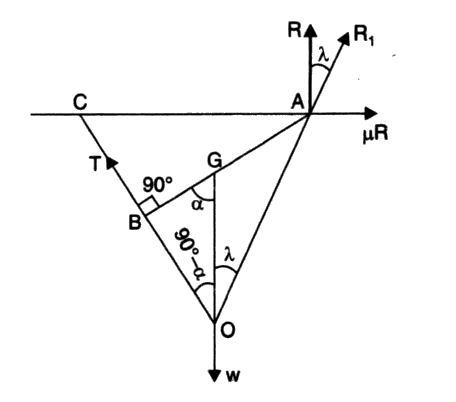
(c) एक भारी एकसमान छड़ ABA B का एक सिरा एक रूक्ष क्षैतिज छड़ ACA C, जिसके साथ वह वलय (रिंग) के द्वारा जुड़ी हुई है, पर सरक सकती है। BB एवं CC एक रस्सी से जुड़े हैं। जब छड़ सर्पण बिंदु पर है, तब AC^(2)-AB^(2)=BC^(2)A C^2-A B^2=B C^2 है। यदि क्षैतिज रेखा व ABA B के बीच का कोण theta\theta है, तो सिद्ध कीजिए कि घर्षण गुणांक (cot theta)/(2+cot^(2)theta)\frac{\cot \theta}{2+\cot ^2 \theta} है।
One end of a heavy uniform rod ABA B can slide along a rough horizontal rod ACA C, to which it is attached by a ring. BB and CC are joined by a string. When the rod is on the point of sliding, then AC^(2)-AB^(2)=BC^(2)A C^2-A B^2=B C^2. If theta\theta is the angle between ABA B and the horizontal line, then prove that the coefficient of friction is (cot theta)/(2+cot^(2)theta)\frac{\cot \theta}{2+\cot ^2 \theta}.
Answer:
Given: One end of a heavy uniform rod ABAB can slide along a rough horizontal rod ACAC, to which it is attached by a ring. BB and CC are joined by a string. When the rod is on the point of sliding, we have AC^(2)-AB^(2)=BC^(2)AC^2-AB^2=BC^2.
Let mm be the mass of the rod, gg the acceleration due to gravity, NN the normal force acting on the ring in a clockwise direction, TT the force on the string, and ff the frictional force.
In equilibrium, we have:
Horizontal net force sumF_(H)=0\sum F_H = 0
Vertical net force sumF_(V)=0\sum F_V = 0
Net torque sum tau=0\sum \tau = 0
Then, the force on the rod is given by mg=T sin theta+Nmg = T \sin \theta + N, which can be written as:
T sin theta=mg-N—-(1)T \sin \theta = mg – N—- (1)
The force in the horizontal direction (ff) is equal to mu N\mu N, where mu\mu is the coefficient of friction. This can be expressed as:
So, the coefficient of friction is (cot theta)/(2+cot^(2)theta)\frac{\cot \theta}{2 + \cot ^2 \theta}.
(d) एक कण का पृथ्वी द्वारा आकर्षण बल उस कण के पृथ्वी के केन्द्र से दूरी के वर्ग के व्युत्क्रमानुपाती है। एक कण, जिसका भार पृथ्वी की सतह पर WW है, सतह से 3h3 h ऊँचाई से पृथ्वी की सतह पर गिरता है। दर्शाइए कि पृथ्वी के आकर्षण बल द्वारा किए गए कार्य का परिमाण (3)/(4)hW\frac{3}{4} h W है, जहाँ hh पृथ्वी की त्रिज्या है।
The force of attraction of a particle by the earth is inversely proportional to the square of its distance from the earth’s centre. A particle, whose weight on the surface of the earth is WW, falls to the surface of the earth from a height 3h3 h above it. Show that the magnitude of work done by the earth’s attraction force is (3)/(4)hW\frac{3}{4} h W, where hh is the radius of the earth.
Answer:
Given that the force of attraction of a particle by the earth is inversely proportional to the square of its distance from the earth’s center, we can express it as:
F prop(1)/(“distance”^(2))F \propto \frac{1}{\text{distance}^2}
The weight of a particle on the surface of the earth is denoted as WW, and the radius of the earth is hh. The distance between the earth’s surface and the particle is 3h3h.
The difference in distance between the two positions (initial and final) of the particle is 3h-h=2h3h – h = 2h. According to Newton’s law of universal gravitation:
F=(Gm_(1)m_(2))/(d^(2))F = \frac{G m_1 m_2}{d^2}
where FF is the force of attraction, GG is the gravitational constant, m_(1)m_1 and m_(2)m_2 are the masses of the two objects, and dd is the distance between their centers.
Because the force is inversely proportional to d^(2)d^2, doubling the distance between two masses reduces the gravitational force to (1)/(4)\frac{1}{4} of its original value.
Now, let’s calculate the work done:
“Work done”=F*d=int F=(W)/(4h^(2))*3h*h=(3Wh)/(4)\text{Work done} = F \cdot d = \int F = \frac{W}{4h^2} \cdot 3h \cdot h = \frac{3Wh}{4}
Therefore, the magnitude of the work done by the earth’s attraction force is (3)/(4)hW\frac{3}{4}hW.
(e) वक्र x=t,y=t^(2),z=t^(3)x=t, y=t^2, z=t^3 के बिंदु (1,1,1)(1,1,1) पर स्पर्श-रेखा की दिशा में फलन xy^(2)+yz^(2)+zx^(2)x y^2+y z^2+z x^2 का दिशात्मक अवकलज ज्ञात कीजिए।
Find the directional derivative of the function xy^(2)+yz^(2)+zx^(2)x y^2+y z^2+z x^2 along the tangent to the curve x=t,y=t^(2),z=t^(3)x=t, y=t^2, z=t^3 at the point (1,1,1)(1,1,1).
Answer:
Let’s start by finding the gradient of the function f(x,y,z)=xy^(2)+yz^(2)+zx^(2)f(x, y, z) = xy^2 + yz^2 + zx^2:
{:[grad f=(i(del)/(del x)+j(del)/(del y)+k(del)/(del z))f=i(del f)/(del x)+j(del f)/(del y)+k(del f)/(del z)],[=i(y^(2)+2xz)+j(2xy+z^(2))+k(2yz+x^(2))]:}\begin{aligned}
&\nabla f = \left(i \frac{\partial}{\partial x} + j \frac{\partial}{\partial y} + k \frac{\partial}{\partial z}\right) f = i \frac{\partial f}{\partial x} + j \frac{\partial f}{\partial y} + k \frac{\partial f}{\partial z} \\
&= i \left(y^2 + 2xz\right) + j \left(2xy + z^2\right) + k \left(2yz + x^2\right)
\end{aligned}
Now, we need to find the gradient of ff at the point (1,1,1)(1,1,1):
The parametric equation for the curve is given as vec(r)(t)=(t,t^(2),t^(3))\vec{r}(t) = (t, t^2, t^3), and we want to find the directional derivative along the tangent to this curve at the point (1,1,1)(1,1,1).
First, we find the tangent vector to the curve:
(d( vec(r)))/(dt)=i+2tj+3t^(2)k\frac{d\vec{r}}{dt} = i + 2tj + 3t^2k
Now, we normalize this tangent vector to obtain the unit vector hat(n)\hat{n}:
So, the magnitude of the directional derivative of the function along the tangent to the curve at the point (1,1,1)(1,1,1) is (9)/(7)sqrt14\frac{9}{7} \sqrt{14}.
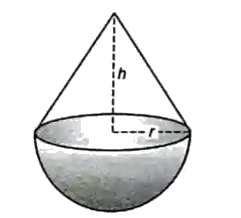
6(a) एक पिण्ड एक शंकु और उसके नीचे अर्धगोले से बना है। शंकु के आधार तथा अर्धगोले के शिखर का अर्धव्यास aa है। पूरा पिण्ड एक रूक्ष क्षैतिज मेज पर रखा है, जिसका अर्धगोला मेज को स्पर्श करता है। दर्शाइए कि शंकु की अधिकतम ऊँचाई, जिससे कि साम्यावस्था स्थिर बनी रहे, sqrt3a\sqrt{3} a है।
A body consists of a cone and underlying hemisphere. The base of the cone and the top of the hemisphere have same radius aa. The whole body rests on a rough horizontal table with hemisphere in contact with the table. Show that the greatest height of the cone, so that the equilibrium may be stable, is sqrt3a\sqrt{3} a.
Answer:
In the given scenario, let’s denote the common base of the hemisphere and the cone as AB\mathrm{AB}, and their common axis as COD\mathrm{COD}, which must be vertical for equilibrium. The hemisphere touches the table at point C\mathrm{C}.
Let H\mathrm{H} be the height of OD\mathrm{OD} of the cone, and a\mathrm{a} be the radius of OA\mathrm{OA} or OC\mathrm{OC} or OB\mathrm{OB} of the hemisphere and the cone, respectively.
Let G_(1)G_1 and G_(2)G_2 be the centers of gravity of the hemisphere and the cone, respectively. Then, OG_(1)=(3a)/(8)O G_1 = \frac{3a}{8} and OG_(2)=(H)/(4)O G_2 = \frac{H}{4}.
To find the height hh of the center of gravity of the combined body (hemisphere and cone) above the point of contact C\mathrm{C}, we can use the formula:
h=((1)/(3)pia^(2)HCG_(2)+(2)/(3)pia^(2)CG_(1))/((1)/(3)pia^(2)H+(2)/(3)pia^(3))h = \frac{\frac{1}{3} \pi a^2 H C G_2 + \frac{2}{3} \pi a^2 C G_1}{\frac{1}{3} \pi a^2 H + \frac{2}{3} \pi a^3}
Therefore, the greatest height of the cone consistent with stable equilibrium of the body is sqrt3a\sqrt{3}a.
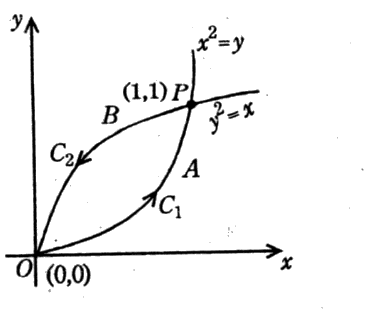
(b) वक्र CC के चारों तरफ vec(F)\vec{F} का परिसंचरण ज्ञात कीजिए, जहाँ vec(F)=(2x+y^(2)) hat(i)+(3y-4x) hat(j)\vec{F}=\left(2 x+y^2\right) \hat{i}+(3 y-4 x) \hat{j} और CC, बिंदु (0,0)(0,0) से बिंदु (1,1)(1,1) तक वक्र y=x^(2)y=x^2 के द्वारा तथा बिंदु (1,1)(1,1) से बिंदु (0,0)(0,0) तक वक्र y^(2)=xy^2=x के द्वारा परिभाषित है।
Find the circulation of vec(F)\vec{F} round the curve CC, where vec(F)=(2x+y^(2)) hat(i)+(3y-4x) hat(j)\vec{F}=\left(2 x+y^2\right) \hat{i}+(3 y-4 x) \hat{j} and CC is the curve y=x^(2)y=x^2 from (0,0)(0,0) to (1,1)(1,1) and the curve y^(2)=xy^2=x from (1,1)(1,1) to (0,0)(0,0).
Answer:
Introduction:
We need to find the circulation of the vector field vec(F)=(2x+y^(2)) hat(i)+(3y-4x) hat(j)\vec{F} = (2x + y^2)\hat{i} + (3y – 4x)\hat{j} around the closed curve CC. This curve CC consists of two parts: the arc OAPOAP and the arc PBOPBO. We’ll denote the first part as C_(1)C_1 and the second part as C_(2)C_2. C_(1)C_1 is described by y=x^(2)y = x^2, and C_(2)C_2 is described by x=y^(2)x = y^2. We’ll calculate the circulation along both parts and then sum them up to get the circulation around the entire curve CC.
Work/Calculations:
Along C_(1)C_1, we have y=x^(2)y = x^2, which implies dy=2xdxdy = 2x dx, and xx varies from 0 to 1. Along C_(2)C_2, we have x=y^(2)x = y^2, which implies dx=2ydydx = 2y dy, and yy varies from 1 to 0.
Now, let’s calculate F*dr\mathbf{F} \cdot d \mathbf{r}:
Now, we’ll calculate the circulation of F\mathbf{F} around CC by summing up the circulations along C_(1)C_1 and C_(2)C_2:
{:[“Circulation of “F” around “C=oint_(C)F*dr],[=int_(C_(1))F*dr+int_(C_(2))F*dr.]:}\begin{aligned}
\text{Circulation of }\mathbf{F} \text{ around } C &= \oint_C \mathbf{F} \cdot d \mathbf{r} \\
&= \int_{C_1} \mathbf{F} \cdot d \mathbf{r} + \int_{C_2} \mathbf{F} \cdot d \mathbf{r}.
\end{aligned}
{:[=oint_(C)F*dr=int_(C_(1))F*dr+int_(C_(2))F*dr],[=int_(C_(1))[(2x+y^(2))dx+(3y-4x)dy]+int_(C_(2))[(2x+y^(2))dx+(3y-4x)dy]],[=int_(x=0)^(1)[(2x+x^(4))dx+(3x^(2)-4x)2xdx]],[quadquad+int_(y=1)^(0)[(2y^(2)+y^(2))2ydy+(3y-4y^(2))dy]],[=int_(0)^(1)(2x-8x^(2)+6x^(3)+x^(4))dx+int_(1)^(0)(3y-4y^(2)+6y^(3))dy],[=[x^(2)-(8)/(3)x^(3)+(3)/(2)x^(4)+(1)/(5)x^(5)]_(0)^(1)+[(3)/(2)y^(2)-(4)/(3)y^(3)+(3)/(2)y^(4)]_(1)^(0)],[=1-(8)/(3)+(3)/(2)+(1)/(5)-(3)/(2)+(4)/(3)-(3)/(2)],[=1-(4)/(3)+(1)/(5)-(3)/(2)=(30-40+6-45)/(30)=-(49)/(30).]:}\begin{aligned}
& =\oint_C \mathbf{F} \cdot d \mathbf{r}=\int_{C_1} \mathbf{F} \cdot d \mathbf{r}+\int_{C_2} \mathbf{F} \cdot d \mathbf{r} \\
& =\int_{C_1}\left[\left(2 x+y^2\right) d x+(3 y-4 x) d y\right]+\int_{C_2}\left[\left(2 x+y^2\right) d x+(3 y-4 x) d y\right] \\
& =\int_{x=0}^1\left[\left(2 x+x^4\right) d x+\left(3 x^2-4 x\right) 2 x d x\right] \\
& \quad \quad+\int_{y=1}^0\left[\left(2 y^2+y^2\right) 2 y d y+\left(3 y-4 y^2\right) d y\right] \\
& =\int_0^1\left(2 x-8 x^2+6 x^3+x^4\right) d x+\int_1^0\left(3 y-4 y^2+6 y^3\right) d y \\
& =\left[x^2-\frac{8}{3} x^3+\frac{3}{2} x^4+\frac{1}{5} x^5\right]_0^1+\left[\frac{3}{2} y^2-\frac{4}{3} y^3+\frac{3}{2} y^4\right]_1^0 \\
& =1-\frac{8}{3}+\frac{3}{2}+\frac{1}{5}-\frac{3}{2}+\frac{4}{3}-\frac{3}{2} \\
& =1-\frac{4}{3}+\frac{1}{5}-\frac{3}{2}=\frac{30-40+6-45}{30}=-\frac{49}{30} .
\end{aligned}
Conclusion:
The circulation of vec(F)\vec{F} around the closed curve CC is -(49)/(30)-\frac{49}{30}.
(c) (i) अवकल समीकरण
(d^(2)y)/(dx^(2))+(3sin x-cot x)(dy)/(dx)+2ysin^(2)x=e^(-cos x)sin^(2)x\frac{d^2 y}{d x^2}+(3 \sin x-\cot x) \frac{d y}{d x}+2 y \sin ^2 x=e^{-\cos x} \sin ^2 x
को हल कीजिए।
(ii) t^(-1//2)t^{-1 / 2} तथा t^(1//2)t^{1 / 2} का लाप्लास रूपांतर ज्ञात कीजिए। सिद्ध कीजिए कि t^(n+(1)/(2))t^{n+\frac{1}{2}} का लाप्लास रूपांतर
(ii) Find the Laplace transforms of t^(-1//2)t^{-1 / 2} and t^(1//2)t^{1 / 2}. Prove that the Laplace transform of t^(n+(1)/(2))t^{n+\frac{1}{2}}, where n inNn \in \mathbb{N}, is
Laplace Transform of t^(n+1//2)t^{n+1/2} for n inNn \in \mathbb{N}:
Now, let’s prove that the Laplace transform of t^(n+1//2)t^{n+1/2} for n inNn \in \mathbb{N} is given by:
Now, notice that Gamma(n+(3)/(2))\Gamma\left(n+\frac{3}{2}\right) can be expressed as Gamma(n+1+(1)/(2))\Gamma\left(n+1+\frac{1}{2}\right), which completes the proof:
(a) समीकरण x^(2)y^(”)-2xy^(‘)+2y=x^(3)sin xx^2 y^{\prime \prime}-2 x y^{\prime}+2 y=x^3 \sin x के संगत समांगी अवकल समीकरण का रेखीय स्वतंत्र हल निकालिए और तब दिए गए समीकरण का प्राचल-विचरण विधि द्वारा सामान्य हल निकालिए।
Find the linearly independent solutions of the corresponding homogeneous differential equation of the equation x^(2)y^(”)-2xy^(‘)+2y=x^(3)sin xx^2 y^{\prime \prime}-2 x y^{\prime}+2 y=x^3 \sin x and then find the general solution of the given equation by the method of variation of parameters.
Answer:
Homogeneous Differential Equation:
We are given the differential equation:
x^(2)y^(”)-2xy^(‘)+2y=x^(3)sin xx^2 y^{\prime \prime}-2 x y^{\prime}+2 y=x^3 \sin x
Step 1: Rewrite the Equation:
Rewrite the given differential equation as:
x^(2)(d^(2)y)/(dx^(2))-2x(dy)/(dx)+2y=x^(3)sin xx^2 \frac{d^2 y}{d x^2}-2 x \frac{d y}{d x}+2 y=x^3 \sin x
Step 2: Change of Variable:
Let’s make a change of variable by putting x=e^(z)x=e^z, which implies (d)/(dz)-=D\frac{d}{dz} \equiv D. Then, our equation becomes:
Step 9: Back to the Original Variable:
Converting back to the original variable xx, the general solution is:
y=c_(1)x+c_(2)x^(2)-x sin xy=c_1 x + c_2 x^2 – x \sin x
Conclusion:
The linearly independent solutions of the corresponding homogeneous differential equation are y_(1)=xy_1=x and y_(2)=x^(2)y_2=x^2, and the general solution of the given equation, using the method of variation of parameters, is:
y=c_(1)x+c_(2)x^(2)-x sin xy=c_1 x + c_2 x^2 – x \sin x
(b) कुंडलिनी x=a cos u,y=a sin u,z=au tan alphax=a \cos u, y=a \sin u, z=a u \tan \alpha के लिए वक्रता की त्रिज्या तथा विमोटन की त्रिज्या ज्ञात कीजिए।
Find the radius of curvature and radius of torsion of the helix x=a cos ux=a \cos u, y=a sin u,z=au tan alphay=a \sin u, z=a u \tan \alpha.
Answer:
Given Helix Equations:
The parametric equations for the helix are:
x=a cos ux=a \cos u
y=a sin uy=a \sin u
z=au tan alphaz=a u \tan \alpha
Step 1: Find the Derivatives of rr:
We first find the derivatives of the position vector r=(x,y,z)\mathbf{r}=(x, y, z) with respect to the parameter uu:
{:[r^(˙)=(dr)/(du)=(x^(˙)”,”y^(˙)”,”z^(˙))],[=a(-sin u”,”cos u”,”tan alpha)]:}\begin{aligned}
\dot{r}&=\frac{d\mathbf{r}}{du}=(\dot{x}, \dot{y}, \dot{z})\\
&=a(-\sin u, \cos u, \tan \alpha)
\end{aligned}
{:[r^(¨)=(d(r^(˙)))/(du)=(x^(¨)”,”y^(¨)”,”z^(¨))],[=a(-cos u”,”-sin u”,”0)]:}\begin{aligned}
\ddot{r}&=\frac{d\dot{r}}{du}=(\ddot{x}, \ddot{y}, \ddot{z})\\
&=a(-\cos u, -\sin u, 0)
\end{aligned}
{:[r^(⃛)=(d(r^(¨)))/(du)=(x^(⃛)”,”y^(⃛)”,”z^(⃛))],[=a(sin u”,”-cos u”,”0)]:}\begin{aligned}
\dddot{r}&=\frac{d\ddot{r}}{du}=(\dddot{x}, \dddot{y}, \dddot{z})\\
&=a(\sin u, -\cos u, 0)
\end{aligned}
Step 2: Find the Cross Product r^(˙)xxr^(¨)\dot{r} \times \ddot{r}:
Next, we calculate the cross product r^(˙)xxr^(¨)\dot{r} \times \ddot{r}:
|[i,j,k],[-a sin u,a cos u,a tan alpha],[-a cos u,-a sin u,0]|\begin{vmatrix}
i & j & k \\
-a\sin u & a\cos u & a\tan \alpha \\
-a\cos u & -a\sin u & 0
\end{vmatrix}
Using the determinant:
{:[r^(˙)xxr^(¨)=(a^(2)sin u tan alpha)i-(a^(2)cos u tan alpha)j+(a^(2))k],[=a^(2)sin u tan alphai-a^(2)cos u tan alphaj+a^(2)k]:}\begin{aligned}
\dot{r} \times \ddot{r} &= (a^2\sin u\tan\alpha)\mathbf{i} – (a^2\cos u\tan\alpha)\mathbf{j} + (a^2)\mathbf{k}\\
&= a^2 \sin u \tan \alpha \mathbf{i} – a^2 \cos u \tan \alpha \mathbf{j} + a^2 \mathbf{k}
\end{aligned}
Step 3: Find the Magnitude of r^(˙)xxr^(¨)\dot{r} \times \ddot{r}:
Now, let’s find the magnitude of r^(˙)xxr^(¨)\dot{r} \times \ddot{r}:
{:[|r^(˙)xxr^(¨)|=sqrt((a^(2)sin u tan alpha)^(2)+(-a^(2)cos u tan alpha)^(2)+(a^(2))^(2))],[=sqrt(a^(4)sin^(2)utan^(2)alpha+a^(4)cos^(2)utan^(2)alpha+a^(4))],[=sqrt(a^(4)(sin^(2)utan^(2)alpha+cos^(2)utan^(2)alpha+1))],[=sqrt(a^(4)(tan^(2)alpha+1))],[=a^(2)sqrt(tan^(2)alpha+1)],[=a^(2)sec alpha]:}\begin{aligned}
|\dot{r} \times \ddot{r}| &= \sqrt{(a^2 \sin u \tan \alpha)^2 + (-a^2 \cos u \tan \alpha)^2 + (a^2)^2}\\
&= \sqrt{a^4 \sin^2 u \tan^2 \alpha + a^4 \cos^2 u \tan^2 \alpha + a^4}\\
&= \sqrt{a^4 (\sin^2 u \tan^2 \alpha + \cos^2 u \tan^2 \alpha + 1)}\\
&= \sqrt{a^4 (\tan^2 \alpha + 1)}\\
&= a^2 \sqrt{\tan^2 \alpha + 1}\\
&= a^2 \sec \alpha
\end{aligned}
Step 4: Find |r^(˙)||\dot{r}|:
The magnitude of the velocity vector |r^(˙)||\dot{r}| is:
|r^(˙)|=sqrt((-a sin u)^(2)+(a cos u)^(2)+(a tan alpha)^(2))|\dot{r}| = \sqrt{(-a\sin u)^2 + (a\cos u)^2 + (a\tan\alpha)^2}
=sqrt(a^(2)(sin^(2)u+cos^(2)u+tan^(2)alpha))= \sqrt{a^2 (\sin^2 u + \cos^2 u + \tan^2 \alpha)}
Step 6: Find the Radius of Curvature rho\rho:
The radius of curvature rho\rho is the reciprocal of the curvature:
rho=(1)/(k)=asec^(2)alpha\rho = \frac{1}{k} = a \sec^2 \alpha
Conclusion:
The radius of curvature of the given helix is rho=asec^(2)alpha\rho = a \sec^2 \alpha.
(c) yy-अक्ष की दिशा में गतिमान एक कण का मूलबिंदु की ओर त्वरण FyF y है, जहाँ F,yF, y का एक धनात्मक एवं सम फलन है। जब कण y=-ay=-a तथा y=ay=a के बीच में कंपन करता है, तब उसका आवर्तकाल TT है। दर्शाइए कि
(2pi)/(sqrt(F_(1))) < T < (2pi)/(sqrt(F_(2)))\frac{2 \pi}{\sqrt{F_1}}<T<\frac{2 \pi}{\sqrt{F_2}}
जहाँ F_(1)F_1 एवं F_(2)F_2 परास [-a,a][-a, a] में FF के अधिकतम एवं न्यूनतम मान हैं। आगे दर्शाइए कि जब लंबाई ll का एक सरल लोलक ऊर्ध्वाधर रेखा के किसी भी ओर 30^(@)30^{\circ} तक दोलन करता है, तब T,2pisqrt(l//g)T, 2 \pi \sqrt{l / g} तथा 2pisqrt(l//g)sqrt(pi//3)2 \pi \sqrt{l / g} \sqrt{\pi / 3} के बीच में रहता है।
A particle moving along the yy-axis has an acceleration FyF y towards the origin, where FF is a positive and even function of yy. The periodic time, when the particle vibrates between y=-ay=-a and y=ay=a, is TT. Show that
(2pi)/(sqrt(F_(1))) < T < (2pi)/(sqrt(F_(2)))\frac{2 \pi}{\sqrt{F_1}}<T<\frac{2 \pi}{\sqrt{F_2}}
where F_(1)F_1 and F_(2)F_2 are the greatest and the least values of FF within the range [-a,a][-a, a]. Further, show that when a simple pendulum of length ll oscillates through 30^(@)30^{\circ} on either side of the vertical line, TT lies between 2pisqrt(l//g)2 \pi \sqrt{l / g} and 2pisqrt(l//g)sqrt(pi//3)2 \pi \sqrt{l / g} \sqrt{\pi / 3}
Answer:
Given Equation of Motion:
The particle’s motion along the yy-axis is described by the equation of motion:
y^(¨)=-F(y)y\ddot{y}=-F(y) y
Conservation of Mechanical Energy:
The first integral of this equation of motion yields the conservation of mechanical energy:
(1)/(2)y^(˙)^(2)+U(y)=E=U(a)\frac{1}{2} \dot{y}^2 + U(y) = E = U(a)
where
U(y)=int_(0)^(y)F(x)xdxU(y) = \int_0^y F(x) x dx
is the potential energy associated with the force -F(y)y-F(y) y.
Expression for the Period TT:
The time period TT for the particle to vibrate between y=-ay=-a and y=ay=a is given by:
Bounds on TT Using Inequalities:
Now, we want to find bounds on TT using inequalities for F(y)F(y). We have F_(2) <= F(y) <= F_(1)F_2 \leq F(y) \leq F_1 for yy in the interval [0,a][0, a]. Using this inequality, we derive lower and upper bounds for TT:
(2pi)/(sqrt(F_(1))) < T < (2pi)/(sqrt(F_(2)))\frac{2\pi}{\sqrt{F_1}} < T < \frac{2\pi}{\sqrt{F_2}}
Comparison with Simple Pendulum:
For a simple pendulum of length ll oscillating through 30^(@)30^\circ on either side of the vertical line, the equation of motion is given by:
The maximum and minimum values of F(theta)F(\theta) in the interval [-30^(@),30^(@)][-30^\circ, 30^\circ] (or [-(pi)/(6),(pi)/(6)]\left[-\frac{\pi}{6}, \frac{\pi}{6}\right] in radians) are F_(1)=(g)/(l)F_1 = \frac{g}{l} and F_(2)=(3g)/(pi l)F_2 = \frac{3g}{\pi l}, respectively.
Inserting these values into the previously established inequality (5), we find that the period TT of the simple pendulum when it oscillates through 30^(@)30^\circ lies between 2pisqrt((l)/(g))2\pi\sqrt{\frac{l}{g}} and 2pisqrt((pi)/(3)(l)/(g))2\pi\sqrt{\frac{\pi}{3}\frac{l}{g}}:
2pisqrt((l)/(g)) < T < 2pisqrt((pi)/(3)(l)/(g))2\pi\sqrt{\frac{l}{g}} < T < 2\pi\sqrt{\frac{\pi}{3}\frac{l}{g}}
Also find the complete primitive of the given differential equation. Give the geometrical interpretations of the complete primitive and singular solution.
b. c:y=x tan alphac: y=x \tan \alpha, which represents a line with slope tan alpha\tan \alpha and passes through the origin.
The geometrical interpretation of the singular solution is that it consists of two parts: a point on the x-axis and a line with slope tan alpha\tan \alpha passing through the origin.
This concludes the solution and interpretations of the given differential equation and its primitive.
(b) एक गतिमान ग्रह का त्वरण (mu)/(” (दूरी “^(2))\frac{\mu}{\text { (दूरी }^2} के बराबर है और त्वरण की दिशा हमेशा एक स्थिर बिंदु (तारा) की ओर है। सिद्ध कीजिए कि उस ग्रह का पथ एक शंकु-परिच्छेद है। वे प्रतिबंध ज्ञात कीजिए, जिनके अन्तर्गत पथ (i) दीर्घवृत्त, (ii) परवलय और (iii) अतिपरवलय बन जाता है।
Prove that the path of a planet, which is moving so that its acceleration is always directed to a fixed point (star) and is equal to (mu)/(” (distance) “^(2))\frac{\mu}{\text { (distance) }^2}, is a conic section. Find the conditions under which the path becomes (i) ellipse, (ii) parabola and (iii) hyperbola.
Answer:
Given that the force is always directed to a fixed point (star), this represents a case of a central orbit.
Also, it is given that the central acceleration is rho=(mu)/(r^(2))\rho = \frac{\mu}{r^2}, where rr is the distance.
The differential equation of the path (in pedal form) is:
(h^(2))/(p^(3))(dp)/(dr)=p=(mu)/(r^(2))\frac{h^2}{p^3} \frac{\mathbf{d} p}{\mathbf{d} r} = p = \frac{\mu}{r^2}
Multiplying both sides by -2, we get:
-(2h^(2))/(p^(3))dp=(-2mu)/(r^(2))dr-\frac{2 h^2}{p^3} \mathbf{d} p = \frac{-2 \mu}{r^2} \mathbf{d} r
respectively, where in the case of an ellipse, 2a2a and 2b2b are the lengths of the major and minor axes; in the case of a parabola, 4a4a is the length of the latus rectum; and in the case of a hyperbola, 2a2a and 2b2b are the lengths of the transverse and conjugate axes.
Since equation (1) can be any of the above 3 forms, three cases arise here:
Case (i) – Elliptic Path:
Comparing (1) with (b^(2))/(p^(2))=(2a)/(r)-1\frac{b^2}{p^2} = \frac{2a}{r} – 1, the pedal equation of the ellipse, we have:
Substituting in (1), for a hyperbolic path, we have v^(2)=mu((2)/(r)+(1)/(a))v^2 = \mu \left(\frac{2}{r} + \frac{1}{a}\right) (Obviously here, v^(2) > (2mu)/(r)v^2 > \frac{2 \mu}{r}).
Summary:
If v^(2)=mu((2)/(r)-(1)/(a))v^2 = \mu \left(\frac{2}{r} – \frac{1}{a}\right) or v^(2) < (2mu)/(r)v^2 < \frac{2 \mu}{r}, then the path is an ellipse.
If v^(2)=(2mu)/(r)v^2 = \frac{2 \mu}{r}, then the path is a parabola.
If v^(2) > (2mu)/(r)v^2 > \frac{2 \mu}{r} or v^(2)=(2mu)/(r)+(r)/(a)v^2 = \frac{2 \mu}{r} + \frac{r}{a}, then the path is a hyperbola.
Additionally, the magnitude of the velocity at any point is independent of the direction of the velocity at that time.
We have also found that h^(2)=mu lh^2 = \mu l in all three cases, where ll is the length of the semi-latus rectum.
(c) (i) गाउस के अपसरण प्रमेय का कथन लिखिए। इस प्रमेय को vec(F)=4x hat(i)-2y^(2) hat(j)+z^(2) hat(k)\vec{F}=4 x \hat{i}-2 y^2 \hat{j}+z^2 \hat{k} के लिए x^(2)+y^(2)=4,z=0x^2+y^2=4, z=0 और z=3z=3 से घिरे हुए क्षेत्र में सत्यापित कीजिए।
(ii) स्टोक्स प्रमेय के द्वारा oint_(C)e^(x)dx+2ydy-dz\oint_C e^x d x+2 y d y-d z का मान ज्ञात कीजिए, जहाँ CC, वक्र x^(2)+y^(2)=4x^2+y^2=4, z=2z=2 है।
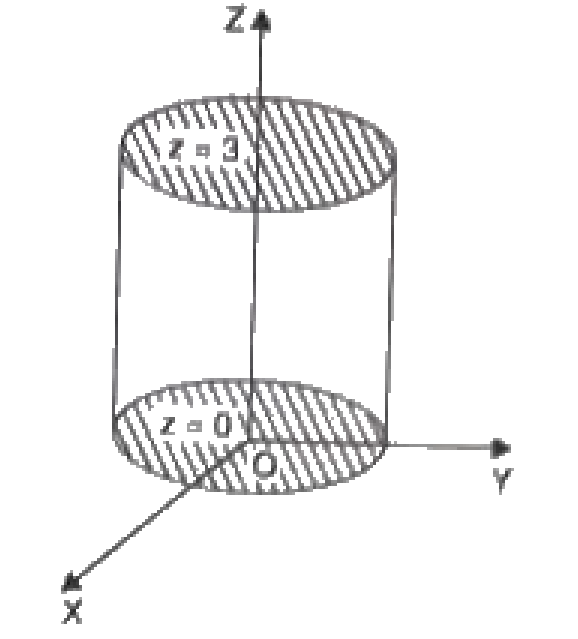
(i) State Gauss divergence theorem. Verify this theorem for vec(F)=4x hat(i)-2y^(2) hat(j)+z^(2) hat(k)\vec{F}=4 x \hat{i}-2 y^2 \hat{j}+z^2 \hat{k}, taken over the region bounded by x^(2)+y^(2)=4,z=0x^2+y^2=4, z=0 and z=3z=3.
Answer:
Gauss divergence theorem
If vec(F)\vec{F} is a vector point function having continuous first order partial derivatives in the region V bounded by a closed surface SS, then
∬_(S) vec(F)* hat(n)dS=∭_(V)div vec(F)dV\iint_S \vec{F} \cdot \hat{n} d S=\iiint_V \operatorname{div} \vec{F} d V
where hat(n)\hat{n} is the outward drawn unit normal vector to the surface S\mathrm{S}.
Since div vec(F)=(del)/(del x)(4x)+(del)/(del y)(-2y^(2))+(del)/(del z)(z^(2))=4-4y+2z\vec{F}=\frac{\partial}{\partial x}(4 x)+\frac{\partial}{\partial y}\left(-2 y^2\right)+\frac{\partial}{\partial z}\left(z^2\right)=4-4 y+2 z
:.quad∭_(V)div vec(F)dV=∭_(V)(4-4y+2z)dxdydz=int_(-2)^(2)int_(-sqrt(4-x^(2)))^(sqrt(4-x^(2)))int_(0)^(3)(4-4y+2z)dzdydx\therefore \quad \iiint_V \operatorname{div} \vec{F} d V=\iiint_V(4-4 y+2 z) d x d y d z=\int_{-2}^2 \int_{-\sqrt{4-x^2}}^{\sqrt{4-x^2}} \int_0^3(4-4 y+2 z) d z d y d x
{:[=int_(-2)^(2)int_(-sqrt(4-x^(2)))^(sqrt(4-x^(2)))[4z-4yz+z^(2)]_(0)^(3)dydx],[=int_(-2)^(2)int_(-sqrt(4-x^(2)))^(sqrt(4-x^(2)))(12-12 y+9)dydx],[=int_(-2)^(2)[21 y-6y^(2)]_(-sqrt(4-x^(7)))^(sqrt(4-x^(7)))dx],[=int_(-2)^(2)42sqrt(4-x^(2))dx=84int_(0)^(2)sqrt(4-x^(2))dx],[=84[(xsqrt(4-x^(2)))/(2)+(4)/(2)sin^(-1)((x)/(2))]_(0)^(2)],[=84[2sin^(-1)1]=84[2xx(pi)/(2)]=84 pi]:}\begin{aligned}
& =\int_{-2}^2 \int_{-\sqrt{4-x^2}}^{\sqrt{4-x^2}}\left[4 z-4 y z+z^2\right]_0^3 d y d x \\
& =\int_{-2}^2 \int_{-\sqrt{4-x^2}}^{\sqrt{4-x^2}}(12-12 y+9) d y d x \\
& =\int_{-2}^2\left[21 y-6 y^2\right]_{-\sqrt{4-x^7}}^{\sqrt{4-x^7}} d x \\
& =\int_{-2}^2 42 \sqrt{4-x^2} d x=84 \int_0^2 \sqrt{4-x^2} d x \\
& =84\left[\frac{x \sqrt{4-x^2}}{2}+\frac{4}{2} \sin ^{-1} \frac{x}{2}\right]_0^2 \\
& =84\left[2 \sin ^{-1} 1\right]=84\left[2 \times \frac{\pi}{2}\right]=84 \pi
\end{aligned}
To evaluate the surface integral, divide the closed surface SS of the cylinder into 3 parts. S_(1)\mathrm{S}_1 : the circular base in the plane z=0z=0 S_(2)\mathrm{S}_2 : the circular top in the plane z=3z=3 S_(3)\mathrm{S}_3 : the curved surface of the cylinder, given by the equation x^(2)+y^(2)=4x^2+y^2=4.
Also ∬_(S) vec(F)* hat(n)dS=∬_(S_(1)) vec(F)* hat(n)dS+∬_(S_(2)) vec(F)* hat(n)dS+∬_(S_(a)) vec(F)* hat(n)dS\iint_{\mathrm{S}} \overrightarrow{\mathrm{F}} \cdot \hat{n} d \mathrm{~S}=\iint_{\mathrm{S}_1} \overrightarrow{\mathrm{F}} \cdot \hat{n} d \mathrm{~S}+\iint_{\mathrm{S}_2} \overrightarrow{\mathrm{F}} \cdot \hat{n} d \mathrm{~S}+\iint_{\mathrm{S}_{\mathrm{a}}} \overrightarrow{\mathrm{F}} \cdot \hat{n} d \mathrm{~S}
On S_(1)(z=0)\mathrm{S}_1(z=0), we have hat(n)=- hat(k), vec(F)=4x hat(i)-2y^(2) hat(j)\hat{n}=-\hat{k}, \overrightarrow{\mathrm{F}}=4 x \hat{i}-2 y^2 \hat{j}
so that
:.quad∬_(S_(1)) vec(F)* hat(n)dS=0\therefore \quad \iint_{\mathrm{S}_1} \overrightarrow{\mathrm{F}} \cdot \hat{n} d \mathrm{~S}=0
On S_(2)(z=3)\mathrm{S}_2(z=3), we have hat(n)= hat(k), vec(F)=4x hat(i)-2y^(2) hat(j)+9 hat(k)\hat{n}=\hat{k}, \overrightarrow{\mathrm{F}}=4 x \hat{i}-2 y^2 \hat{j}+9 \hat{k}
so that
{:[ vec(F)* hat(n)=(4x( hat(i))-2y^(2)( hat(j))+9( hat(k)))* hat(k)=9],[:.quad∬_(S_(2)) vec(F)* hat(n)dS=∬_(S_(2))9dxdy=9∬_(S)dxdy],[=9xx” area of surface “S_(2)=9(pi*2^(2))=36 pi]:}\begin{aligned}
\overrightarrow{\mathrm{F}} \cdot \hat{n} & =\left(4 x \hat{i}-2 y^2 \hat{j}+9 \hat{k}\right) \cdot \hat{k}=9 \\
\therefore \quad \iint_{\mathrm{S}_2} \overrightarrow{\mathrm{F}} \cdot \hat{n} d \mathrm{~S} & =\iint_{\mathrm{S}_2} 9 d x d y=9 \iint_{\mathrm{S}} d x d y \\
& =9 \times \text { area of surface } \mathrm{S}_2=9\left(\pi \cdot 2^2\right)=36 \pi
\end{aligned}
On S_(3),x^(2)+y^(2)=4\mathrm{S}_3, x^2+y^2=4 :. hat(n)=\therefore \hat{n}= a unit vector normal to surface S_(3)=(2x( hat(i))+2y( hat(j)))/(sqrt(4x^(2)+4y^(2)))=(x( hat(i))+y( hat(j)))/(2)\mathrm{S}_3=\frac{2 x \hat{i}+2 y \hat{j}}{\sqrt{4 x^2+4 y^2}}=\frac{x \hat{i}+y \hat{j}}{2}
{:[ vec(F)* hat(n)=(4x( hat(i))-2y^(2)( hat(j))+z^(2)( hat(k)))*((x( hat(i))+y( hat(j)))/(2))=2x^(2)-y^(3)],[x^(2)+y^(2)=4″,”x=2cos theta”,”y=2sin theta” and “dS=2d theta dz.]:}\begin{gathered}
\overrightarrow{\mathrm{F}} \cdot \hat{n}=\left(4 x \hat{i}-2 y^2 \hat{j}+z^2 \hat{k}\right) \cdot\left(\frac{x \hat{i}+y \hat{j}}{2}\right)=2 x^2-y^3 \\
x^2+y^2=4, x=2 \cos \theta, y=2 \sin \theta \text { and } d \mathrm{~S}=2 d \theta d z .
\end{gathered}
Also, on S_(3)\mathrm{S}_3, i.e. x^(2)+y^(2)=4,x=2cos theta,y=2sin thetax^2+y^2=4, x=2 \cos \theta, y=2 \sin \theta and dS=2d theta dzd \mathrm{~S}=2 d \theta d z.
To cover the whole surface S_(3),zS_3, z varies from 0 to 3 and theta\theta varies from 0 to 2pi2 \pi.
The equality of (1) and (2) verifies divergence theorem.
(ii) Evaluate by Stokes’ theorem oint_(C)e^(x)dx+2ydy-dz\oint_C e^x d x+2 y d y-d z, where CC is the curve x^(2)+y^(2)=4,z=2x^2+y^2=4, z=2.
Answer:
Introduction
We are given a vector field vec(F)=e^(x) hat(i)+2y hat(j)- hat(k)\vec{F} = e^x \hat{i} + 2y \hat{j} – \hat{k} and a curve CC defined by x^(2)+y^(2)=4x^2 + y^2 = 4 and z=2z = 2. We want to evaluate oint_(C) vec(F)*d vec(r)\oint_C \vec{F} \cdot d\vec{r} using Stokes’ theorem.
Step 1: Find the Curl of vec(F)\vec{F}
Stokes’ theorem states that oint_(C) vec(F)*d vec(r)=∬_(S)grad xx vec(F)*d vec(S)\oint_C \vec{F} \cdot d\vec{r} = \iint_S \nabla \times \vec{F} \cdot d\vec{S}, where SS is the surface bounded by CC.